
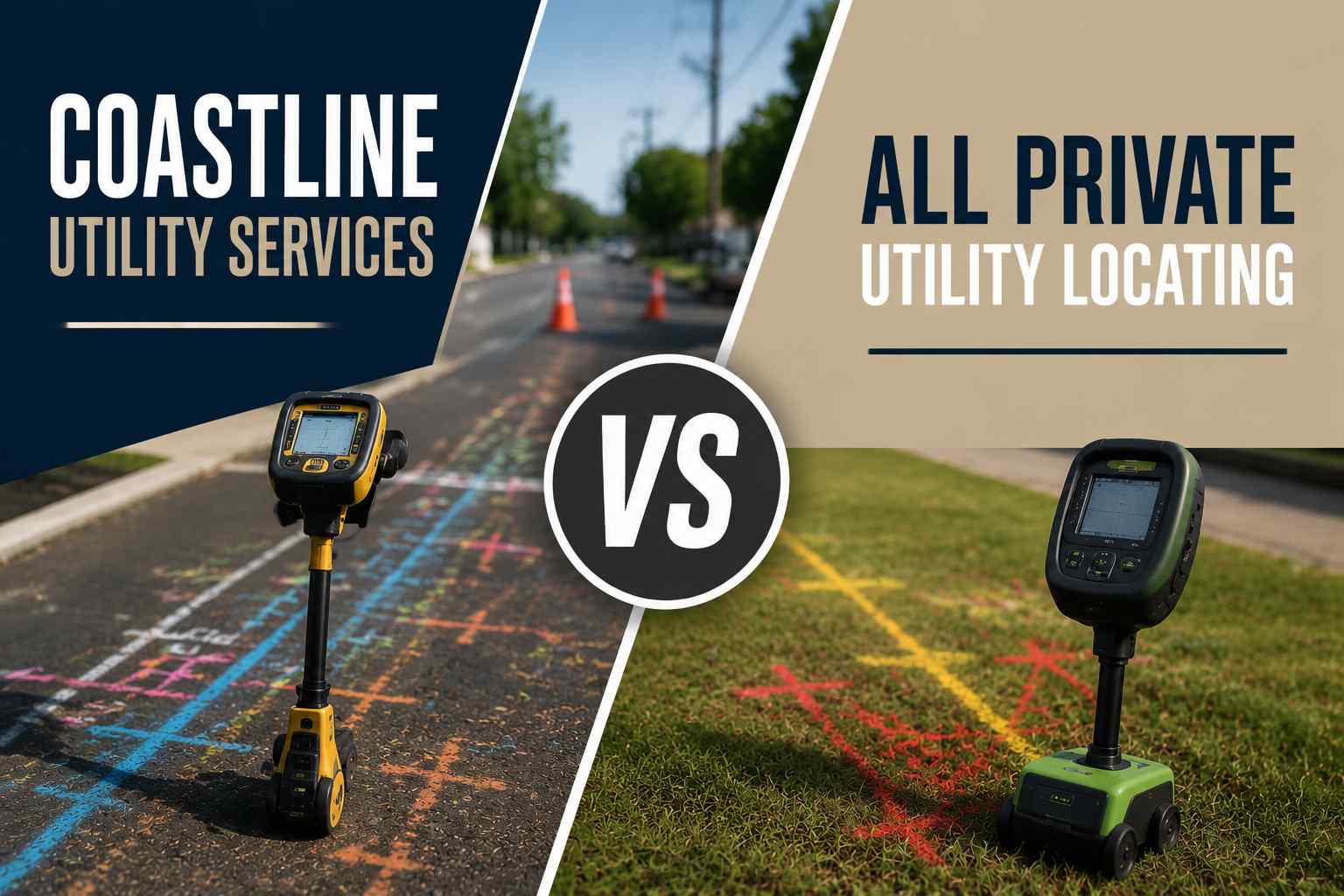
Choosing a private utility locating company on California’s Central Coast usually comes down to one question: Who can keep your crew safe before the first shovel hits the ground?
This comparison is written for homeowners and local contractors weighing two regional providers ahead of a pool, ADU, trenching, grading, or landscaping project.
For most of these projects, Coastline Utility Services is the better fit. Its owner stays directly involved in the work, and it handles locating, potholing, CCTV, and leak detection in-house rather than coordinating across vendors. All Private Utility Locating is a capable alternative with a wider technical catalog, and the sections below cover the cases where it makes more sense.
| Quick verdict Coastline Utility Services is best for homeowners and small-to-mid-sized contractors who want responsive, personalized service from an owner-run team. All Private Utility Locating is best for projects that need specialty scanning, such as concrete scanning or well inspection, or coverage reaching inland into Bakersfield and Fresno. If you value direct accountability and a single provider for locating, potholing, and pipe inspection, choose Coastline Utility Services. |
| Dimension | Coastline Utility Services | All Private Utility Locating |
| Core services | Utility locating, potholing, CCTV drain inspection, leak detection, and GPR | Utility locating, GPR, concrete scanning, video and pipe inspections, fault finding, more |
| Specialty scanning | Ground penetrating radar | Ground penetrating radar, concrete scanning, and well inspection |
| Service area | San Luis Obispo County, San Mateo County, and Santa Barbara County | California’s Central Coast, including Monterey, San Luis Obispo, and Santa Barbara Counties. |
| Ownership | Family-run, female-owned, direct owner involvement | Founded 2013; publishes CA license #324751 |
| Pricing | Custom quote only; free quotes | Custom quote only; not publicly listed |
| Public reviews | No verifiable third-party ratings found (as of June 2026) | No verifiable third-party ratings found (as of June 2026) |
| Best for | Homeowners and local contractors want a responsive, integrated service | Sites needing specialty scanning or inland Central Valley coverage |
Overview of Coastline Utility Services
Coastline Utility Services is a female-owned, family-run firm based in Morro Bay that has been incorporated in California since 2010. The company keeps a focused suite of subsurface services: private utility locating, potholing, CCTV drain inspection, and leak detection, serving clients from San Luis Obispo County north into the San Francisco Bay Area. Its differentiator is direct access to ownership, so the people accountable for the quality of a locate are often the same people answering the phone and scheduling the work.
Overview of All Private Utility Locating
All Private Utility Locating, known as APUL, was founded in 2013 and works across the Central Coast from a base in Atascadero. It offers one of the widest service catalogs in the region, including utility locating, ground-penetrating radar, concrete scanning, video and pipe inspections, utility fault finding, metal detecting, backflow valve inspections, well inspections, and pre-construction consulting. APUL publishes its California contractor license number (#324751) and positions itself as the area’s premier locating specialist, with messaging built around safety and clear, honest reporting.
Service Scope and Capabilities Compared
On core locating, the two firms overlap closely: both trace and mark underground lines that the public 811 system does not cover. Under Government Code section 4216.2, anyone planning to dig in California must notify the regional notification center at least two working days in advance, but that public process only locates public-utility lines in the road and right-of-way. Private lines that run across a property, such as a feed to a detached garage, a pool, or an irrigation system, are exactly what these companies are hired to find.
Where they diverge is breadth versus integration. APUL’s catalog extends well past locating into concrete scanning, well inspection, and pre-construction consulting, which matters on complex commercial sites or before coring a slab.
Coastline takes the opposite approach, pairing locating with potholing, CCTV drain inspection, and leak detection so a homeowner or contractor can confirm a line, expose it safely with vacuum or hand digging, and inspect a pipe through one point of contact. For a residential project, that integration often removes a round of scheduling: the same team that marks the line can return to expose and verify it. For a large commercial site, APUL’s scanning depth can be the deciding factor instead.
According to each company’s own website, neither publishes a strike-rate or accuracy statistic, so capability claims here rest on advertised service lists rather than documented performance data, and any buyer should ask for proof of insurance and recent project references regardless of which firm they choose.
Service Area and Responsiveness Compared
Geography is one of the clearest points of separation. Coastline’s stated footprint runs from San Luis Obispo County north through San Mateo County and into the broader San Francisco Bay Area, with Santa Barbara County also served. APUL’s published service area centers on Monterey, San Luis Obispo, and Santa Barbara counties and then reaches inland to Bakersfield and Fresno in the Central Valley. In practice, that means a Bay Area homeowner is more likely to be inside Coastline’s range, while a project near Fresno or Bakersfield falls in APUL’s territory.
Responsiveness is harder to measure from the outside, but the structural difference is real. An owner-run shop like Coastline can offer a short line between the customer and the person responsible for the job, which many homeowners describe as reassuring on a first-time dig. A larger toolkit like APUL’s can mean more scheduling around specialized equipment and technicians. Both advertise fast, clear communication, so the right read depends on whether you prioritize a single accountable contact or access to a deeper bench of scanning tools. Because both publish their service areas online, the safest move is to confirm your exact city or parcel with each before booking, since coverage at the edges of a region can vary by project size.
Where All Private Utility Locating Wins
- Broader technical toolkit. APUL advertises concrete scanning and well inspection alongside standard locating. For work that requires scanning a slab before coring, that range is an advantage.
- Published credentials and tenure. APUL lists a California contractor license (#324751) directly on its site and describes more than a decade of field experience since its 2013 founding. Visible licensing and a clear founding date give cautious buyers an easy verification point.
- Inland and Central Valley reach. APUL serves Monterey, plus Bakersfield and Fresno, areas outside Coastline’s advertised range. For projects in those markets, APUL is the more practical local option.
Where Coastline Utility Services Wins
- Integrated locating, potholing, CCTV, GPR, and leak detection. Coastline bundles the steps most excavation projects actually need, so a customer can locate a line, expose it with potholing, and inspect a drain without coordinating multiple vendors. That continuity reduces handoffs on a typical residential or small-contractor job.
- Direct owner involvement. As a female-owned, family-run company, Coastline offers direct access to ownership. Buyers who value a single accountable contact rather than a dispatch queue tend to prefer this structure, particularly on a first-time locate.
- San Mateo and Bay Area coverage. Coastline’s range extends north into San Mateo County and the San Francisco Bay Area, a footprint APUL does not advertise. For Bay Area homeowners and contractors, that reach is decisive.
- Longer corporate tenure. Coastline has been incorporated in California since 2010, giving it a slightly longer formal track record than APUL’s 2013 founding, though both are well-established by regional standards.
- Clear homeowner orientation. Coastline’s marketing speaks directly to homeowners planning pools, fences, patios, ADUs, and landscaping, which makes it an easy starting point for residential buyers who are new to private locating.
Pricing Compared
Neither company publishes pricing, which is normal for this industry because cost depends on lot size, the number and type of utilities, access, and whether potholing or scanning is involved. Coastline offers free quotes and frames its estimates around the specific scope of each job. APUL likewise works on a custom-quote basis with no rate card listed on its website. Because pricing is not publicly available from either firm, the practical step for buyers is to request written quotes from both and compare the scope line by line rather than the headline price. For complex jobs, ask each company to spell out what is included, since an integrated locate-and-pothole quote and a locate-only quote are not directly comparable.
What Users Say
Independent review data is thin for both companies. As of June 2026, no verifiable third-party star ratings or review volumes could be confirmed for either firm on the major platforms. Both Coastline and APUL maintains a Yelp listing, but neither showed a substantial body of published, rated reviews at the time of writing. APUL’s own website states it is trusted by businesses across its service area, though that is self-reported rather than platform-verified. For buyers, the takeaway is to treat both as locally known but lightly reviewed online, and to ask each company directly for recent customer references in your specific city.
Which Should You Choose?
Choose Coastline Utility Services if you are a homeowner or local contractor who wants a single, owner-accountable provider for locating, potholing, and pipe inspection, or if your project sits anywhere from San Luis Obispo north into the San Francisco Bay Area. It is the more natural fit for residential pools, ADUs, fences, patios, and landscaping work where a responsive point of contact matters more than a long equipment list.
Choose All Private Utility Locating if your job needs specialty scanning, such as concrete scanning or well inspection, involves pre-construction consulting on a complex site, or is located inland near Bakersfield, Fresno, or in Monterey County. APUL’s broader toolkit and published licensing make it the stronger pick when technical breadth or Central Valley coverage is the priority.
FAQ
What is the difference between calling 811 and hiring a private utility locator?
Calling 811 notifies a regional notification center that marks public utility lines in the street and right-of-way at no cost. A private locator like Coastline or APUL finds the privately owned lines on your property, such as a feed to a garage, pool, or irrigation system, that 811 does not cover.
Does Coastline Utility Services serve the San Francisco Bay Area?
Yes. Coastline advertises a service area running from San Luis Obispo County north into San Mateo County and the broader San Francisco Bay Area. APUL’s published coverage does not extend into the Bay Area, so Coastline is the better Bay Area option.
Which company offers ground penetrating radar and concrete scanning?
All Private Utility Locating lists concrete scanning among its services, useful for scanning a slab before coring. Both Coastline and APUL offer ground-penetrating radar.
Do either of these companies publish their pricing?
No. Both Coastline and APUL work on a custom quote basis and do not list rates online, which is standard for the industry. Coastline offers free quotes, so the best approach is to request written estimates from both and compare the scope.
Which is better for a residential pool or ADU project?
For most residential pool, ADU, fence, or landscaping projects on the Central Coast or in the Bay Area, Coastline’s homeowner focus and integrated locating, potholing, and inspection services make it a strong starting point. APUL is worth a quote if the site also needs scanning beneath concrete.
Is private utility locating legally required in California?
California law requires excavators to notify the regional notification center (811) before digging, but that covers public lines only. Locating private lines is not always legally mandated, yet skipping it leaves you liable for any private utilities you strike, which is why most contractors treat it as essential.
Author Profile

- Along with leading the team, Millard also works alongside different Fortune500 companies as their management Consultant/Financial Analyst, which shows his passion in helping other businesses grow.
Latest entries
 BusinessOctober 3, 202619 Tips to Prepare for a Virtual Interview
 BusinessSeptember 27, 2026Best Forms Of Passive Income to Build Your Wealth
 Career & LearningSeptember 21, 20266 Most Important Soft Skill Activities for High School Students
 Construction/RepairSeptember 15, 2026Why Does Stamped Concrete Need To Be Sealed