
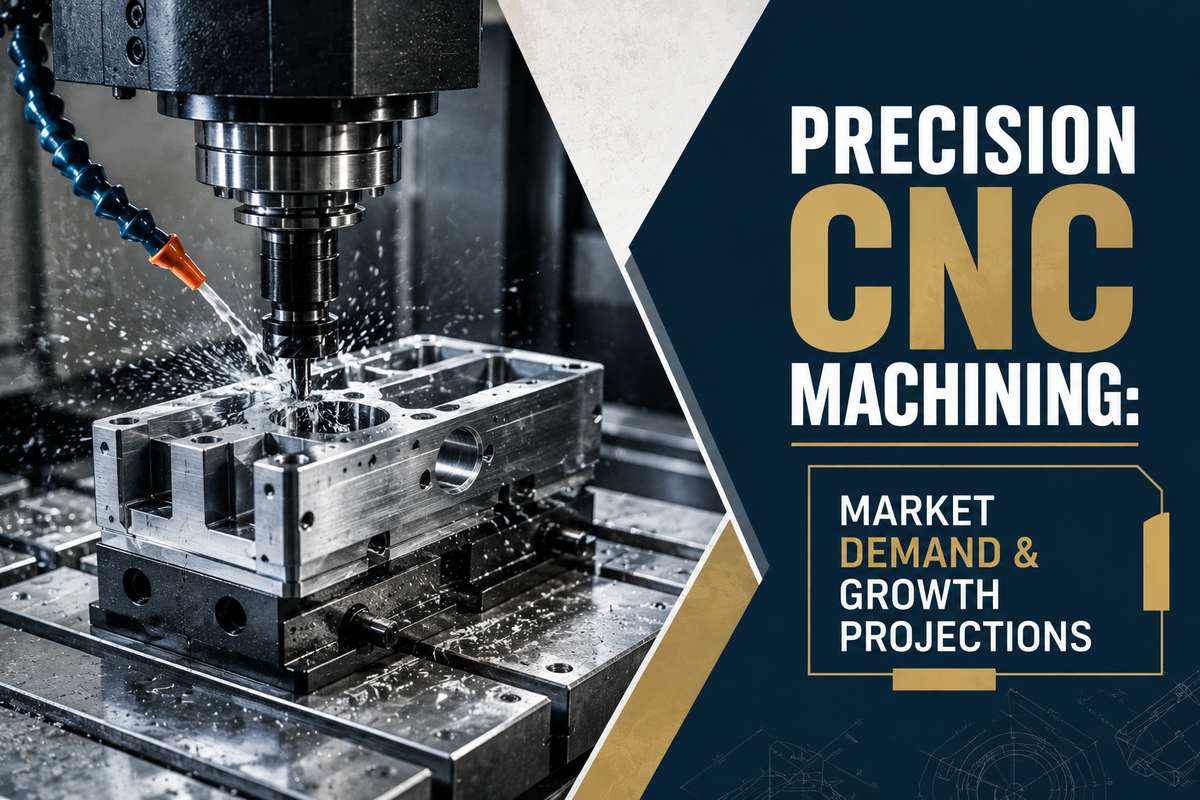
Market Demand and Growth Projections for Precision CNC Machining, 2026 to 2031
1. Executive Summary
1.1 Synthesis Overview
Precision CNC machining sits at the center of one of the most consequential shifts in global manufacturing in a generation. The broad precision machining market was valued at roughly $115 billion to $124 billion in 2025 across the major research firms, with Grand View Research placing it at $123.54 billion and market.us at $117.2 billion. Computer numerical control (CNC) is the dominant mode of production within that market, accounting for a commanding share of activity: Grand View Research attributes 78.9 percent of 2025 precision machining revenue to CNC operation, and dataintelo estimates CNC machining alone at $27.8 billion, or about 38 percent of the precision machining total. Whichever lens is used, CNC is the engine of the sector, and it is growing faster than the manufacturing economy as a whole.
Over the 2026 to 2031 window, published growth rates for the precision machining cluster are in a 6 to 8 percent compound annual growth rate (CAGR) band. Grand View Research projects 8.1 percent through 2033, Fortune Business Insights and Verified Market Research center near 7.6 to 7.8 percent, and more conservative houses such as Dataintelo model 5.9 percent. Applying a defensible mid-point of roughly 7.5 percent to a 2026 base near $130 billion implies a global precision machining market approaching $185 billion to $195 billion by 2031, with the CNC-specific slice expanding proportionally. The North American contract manufacturing market, where independent CNC job shops such as CRD MFG compete, was sized by Grand View Research at $64.5 billion in 2024 and is forecast to reach $101.6 billion by 2030 at 6.8 percent, with CNC machining the single largest service segment at 45.8 percent of revenue.
Directional verdict: strong growth. Demand is being pulled upward simultaneously by aerospace and defense backlogs, electric-vehicle and powertrain components, medical-device miniaturization, semiconductor tooling, and a reshoring wave that is repricing domestic machining capacity as a strategic asset. The constraints are on the supply side, not the demand side: a deepening skilled-labor shortage, tariff-driven input-cost volatility, and the capital intensity of the automation and multi-axis equipment now required to compete. The winners of the next five years will be shops that convert those constraints into moats, pairing 5-axis and multi-process capability with automation, quality certifications, and reshoring-aligned positioning.
[IMAGE SUGGESTION: Headline metric band showing 2025 market size range ($115B-$124B), 2031 projected size (~$185B-$195B), and blended CAGR (~7.5%). Source: Section 1 and Section 2b figures.]
1.2 Key Findings at a Glance
- CNC dominates precision machining. CNC operation represents roughly 73 to 79 percent of precision machining revenue (Grand View Research, market.us), making it the structural core of the sector rather than a niche.
- Growth outpaces manufacturing broadly. A 6 to 8 percent CAGR consensus sits well above overall industrial output growth, driven by rising part complexity and tighter tolerances that manual methods cannot meet.
- Reshoring is a genuine tailwind, though not yet a boom. The ISM Manufacturing PMI hit a multi-year high of 52.7 in March 2026, yet IoT Analytics cautions the data does not yet confirm a full reshoring boom. Domestic machining capacity is nonetheless repricing upward.
- Two markets, one label. A digital-marketplace tier (Xometry, Protolabs, Fictiv) is scaling rapidly on instant quoting and distributed networks, while a fragmented base of independent job shops competes on relationships, complex work, and certifications.
- Consolidation is accelerating. Private-equity roll-ups and strategic acquirers are actively consolidating aerospace, defense, and precision-machining shops, with platform entries priced at 7 to 9 times EBITDA per banker-reported ranges.
2. Present-Day Sector Overview
2a. Sector Definition & Scope
Precision CNC machining is the computer-controlled, subtractive manufacture of components to tight dimensional tolerances, typically at the micrometer level, by removing material from a solid blank through milling, turning, drilling, grinding, and related operations. The scope for this report centers on the CNC-driven portion of the precision machining market and, in particular, the contract and job-shop model in which specialist manufacturers produce custom parts and assemblies for original equipment manufacturers (OEMs) and product developers across regulated and industrial end markets. Adjacent processes frequently sold alongside CNC machining, including laser tube and sheet cutting, CNC tube and pipe bending, robotic welding, and prototyping, are treated here as part of the integrated precision fabrication offering that increasingly defines competitive shops.
The report distinguishes the CNC machining services market (the work performed by shops) from the CNC machine tools market (the equipment sold to them). The two move together but are sized separately: the U.S. CNC machining centers and turning centers equipment market alone was about $2.87 billion in 2023 and is projected by Grand View Research to reach roughly $4.03 billion by 2030. This report is primarily concerned with the services and demand side, where independent manufacturers such as the featured company operate.
2b. Current Market Size & Recent Growth
Market-sizing estimates diverge by scope and methodology, so they are presented here as a range with each figure attributed. For the broad precision machining market, Grand View Research estimated $123.54 billion in 2025, Business Research Insights and several houses cluster near $115 billion to $124 billion, and market.us put the 2025 figure at $117.2 billion. Fortune Business Insights sizes the North America precision machining market at approximately $27.76 billion for 2026 and the U.S. at roughly $23.07 billion. Narrower CNC-only service definitions are smaller: Dataintelo isolates CNC machining at $27.8 billion globally, reflecting the difference between “all precision machining” and “CNC machining services” as a line item.
Recent growth has been robust despite macro noise. The clearest public signal comes from the digital-manufacturing marketplaces: Xometry reported full-year 2025 revenue of $686.6 million, up 25.9 percent year over year, and Protolabs reported record annual revenue of roughly $533 million with CNC machining revenue growing 25 percent in the fourth quarter. These are share-gain stories layered on a market that is itself expanding, and management at Xometry explicitly attributed growth to market-share gains rather than tariff pull-forward.
[IMAGE SUGGESTION: Column chart of precision machining market size from 2026 (~$130B base) toward 2031 (~$185B-$195B), with a secondary series for the CNC-specific slice. Source: Grand View Research, Fortune Business Insights, dataintelo figures in Section 2b.]
2c. Key Demand Drivers
- Rising part complexity and tighter tolerances. Aerospace, defense, medical, and semiconductor components increasingly demand geometries and micron-level tolerances that only multi-axis CNC can achieve, structurally shifting work away from manual methods.
- Aerospace and defense backlogs. Airbus and Boeing backlogs collectively exceed 14,000 aircraft as of early 2026 per data from Intelo, and global defense budgets topped $2.2 trillion in 2024, sustaining multi-year demand for machined structural and engine parts.
- Electric-vehicle and powertrain transformation. EV motor housings, battery structural components, and lightweight parts require precision machining, and Grand View Research notes automotive remained the largest end-use segment in 2025.
- Medical-device miniaturization. The medical-device sector, valued above $550 billion in 2025 per Dataintelo, needs biocompatible implants and surgical instruments machined to sub-micron tolerances under ISO 13485 systems.
- Reshoring and supply-chain resilience. Tariffs, Taiwan and China risk, and total-cost-of-ownership re-math are pulling critical component sourcing back to domestic shops, repricing U.S. capacity upward.
2d. Value Chain & Business Models
The precision CNC value chain runs from design and design-for-manufacturability (DFM) support, through material sourcing, programming (CAD/CAM to G-code), machining and secondary operations (welding, bending, finishing), to inspection, certification, and delivery. Three business models now compete for the same buyers. The digital marketplace model (Xometry, Fictiv, Protolabs Network) uses instant-quoting software and a distributed supplier network to serve prototyping and low-to-mid-volume demand at speed. The integrated in-house manufacturer model (Protolabs core, and thousands of independent shops such as the featured company) controls machining under one roof for consistency and traceability. The specialist tier-supplier model serves regulated OEMs with certified, qualified processes and long-program relationships. Increasingly, the most defensible shops blend elements of all three: in-house control, digital front ends, and certification depth.
2e. Current Headwinds
[IMAGE SUGGESTION: Optional icon row summarizing the five headwinds and their severity ratings. Source: Section 2e table.]
| Headwind | Description | Severity |
| Skilled-labor shortage | An aging workforce and thin apprenticeship pipeline leave roughly 65 percent of shops reporting difficulty finding qualified operators; the U.S. faces a projected shortfall of about 2.1 million skilled workers by 2030 (Yijin, Deloitte/Manufacturing Institute). | High |
| Tariff and input-cost volatility | Raw-material prices rose about 5.4 percent in 2025 with a further 4.4 percent projected for 2026, and tariff unpredictability pressures quoting discipline and margins (ISM, Manufacturing Dive). | High |
| Capital intensity of automation | 5-axis platforms, robotic tending, and lights-out cells demand significant capex, raising the barrier for smaller shops to stay competitive. | Medium |
| Marketplace price and margin pressure | Instant-quote platforms compress lead times and pricing expectations, forcing traditional shops to differentiate on complexity, service, and certification. | Medium |
| End-market cyclicality | Softness in agriculture and trucking tied to tariffs and uncertainty can create uneven order flow for shops exposed to those segments (Stecker Machine). | Medium |
3. Competitive Landscape
3a. Market Leaders
The precision CNC machining landscape has no single dominant provider of services; it is highly fragmented, with the most visible leaders being the digital-manufacturing marketplaces and the large machine-tool builders that supply the equipment. The table below profiles representative leaders across those categories, all with real, recent moves.
| Company / HQ | Market Position | Core Offering | Competitive Moat | Recent Moves | Growth Trajectory |
| Xometry (Maryland, USA) | Leading digital manufacturing marketplace | AI instant-quoting marketplace for CNC, 3D printing, sheet metal | Network scale (over 4,900 active suppliers), Instant Quoting Engine, enterprise procurement software | FY2025 revenue $686.6M, up 25.9%; active buyers up 20% to 81,821; scaling toward $1B revenue target | Strong growth |
| Protolabs (Minnesota, USA) | Pioneer of digital rapid manufacturing | In-house CNC, injection molding, 3D printing plus Protolabs Network | Speed (24-hour turnaround), in-house process control, traceability for regulated work | Record FY2025 revenue ~$533M; Q4 CNC revenue up 25%; launched ProDesk platform and advanced CNC services | Moderate to strong growth |
| Fictiv (California, USA) | Digital manufacturing ecosystem | Managed CNC, injection molding, 3D printing via curated network | Quality standardization across partners, design feedback, global network (US, China, India) | Positioned as consultative alternative to Xometry; expanding certified-partner base | Growth |
| DMG Mori / Yamazaki Mazak / Okuma (Japan/Germany) | Global machine-tool builders | 5-axis machining centers, turning centers, automation cells | Advanced multi-axis platforms, installed base, service networks anchoring the equipment supply | Continued push into automation, digital controls, and hybrid additive-subtractive systems | Steady growth |
| Haas Automation (California, USA) | Largest US machine-tool builder by volume | Affordable CNC mills, lathes, and rotary products for SMB shops | Price accessibility, dealer network, ubiquity among American job shops | Broadening portfolio and financing options as equipment costs decline | Steady growth |
| PE-backed platforms (Threadlock, PrecisionX, PMGC) | Consolidators of independent shops | Rolled-up multi-site precision machining and aerospace capacity | Scale, capital, cross-selling of certified capabilities across acquired shops | Threadlock rolled up J&F, Kremin, R&S; PMGC added SVM, Indarg, A&B Aerospace in 2025-2026 | Rapid inorganic growth |
[IMAGE SUGGESTION: Competitive-positioning quadrant plotting digital marketplaces, integrated in-house manufacturers, machine-tool builders, and PE consolidators by scale versus specialization. Source: Section 3a profiles.]
3b. Emerging Challengers
- Jiga. A relationships-first sourcing platform positioning against marketplace anonymity by giving engineering teams direct, persistent supplier relationships from prototype through production.
- CloudNC / CAM Assist. AI CAM-programming tools that auto-generate machining strategies inside existing workflows, directly targeting the programming-labor bottleneck that constrains shop capacity.
- Regional Swiss and multi-axis specialists. Shops adding Swiss turning, 5-axis milling, and NADCAP or semiconductor qualifications are becoming prime acquisition targets and premium-priced suppliers.
- Reshoring-native automated shops. Operators like NEDCO and Marlin Steel have used automation to win back offshore work, with automation cutting labor costs sharply and pushing the reshored share of revenue past 70 percent in documented cases.
Company Spotlight: CRD MFG, Inc.
CRD MFG, Inc. is a full-service precision manufacturing partner based in Placentia, Orange County, California, operating in exactly the fragmented independent-shop tier where most of the sector’s value is created. The company positions itself around a single promise, “From Concept to Creation,” offering an integrated set of capabilities under one roof: CNC machining, CNC tube and pipe bending, laser tube cutting, robotic welding, sheet-metal fabrication, and product development, spanning one-off prototyping through full-scale mass production. It serves demanding end markets including automotive (notably high-performance aftermarket), aerospace and defense, industrial and commercial fabrication, medical devices, and electronics, working with clients coast to coast.
Sub-segment and model. CRD MFG plays in the integrated in-house manufacturer tier, the counterpoint to the anonymous-marketplace model. Its structural bet is that buyers of complex, multi-process parts value a single accountable partner over a distributed network. That thesis maps directly onto two of the strongest demand drivers in this report: the shift toward complex geometries that reward multi-process integration, and the reshoring of critical work to domestic, relationship-driven suppliers.
Differentiation and moat. The company’s honest competitive advantages are consolidation of services (laser cutting, machining, bending, and welding in one shop, reducing multi-vendor handoffs and secondary-operation delays) and a single-point-of-contact model in which a dedicated project manager owns each project end to end. For “The Innovator” (startups and product developers), “The Optimizer” (established manufacturers outsourcing specialized work), and “The Problem-Solver” (engineers facing complex geometries and reverse-engineering needs), that integration converts fragmented, slow supply chains into one managed workflow. In a market where marketplaces compete on instant quotes, CRD MFG competes on ownership of the whole part.
Honest read on positioning. CRD MFG is a small, privately held operator, not a market leader, and it competes in a landscape where digital marketplaces are winning share on speed and where PE-backed platforms are aggregating certified capacity at 7-to-9-times-EBITDA valuations. Its scale signals (a modest public and social footprint) place it firmly in the independent-shop tier. The strategic implication is favorable but conditional: the same forces creating premium valuations for certified, multi-capability domestic shops are the forces CRD MFG is positioned to ride, provided it continues to deepen certifications (for example, AS9100 and ITAR readiness for aerospace and defense work), invests in multi-axis and automation capacity to offset labor scarcity, and makes its integrated, single-contact model legible to buyers who default to marketplace quoting. Where it must be candid: competing on complexity and service, not on price against instant-quote platforms, and building the certification and traceability depth that regulated OEMs now require.
3c. Competitive Dynamics (Porter’s Five Forces)
| Force | Rating | Rationale |
| Threat of new entrants | Medium | Basic 3-axis capacity is accessible, but competitive capability now requires costly 5-axis platforms, automation, and hard-won certifications, raising the effective barrier. |
| Bargaining power of buyers | High | OEMs can multi-source, and instant-quote marketplaces give buyers price transparency and easy switching for standard parts; complex, qualified work reduces this power. |
| Bargaining power of suppliers | Medium | Machine-tool builders and material suppliers hold pricing leverage amplified by tariffs, though multiple equipment vendors and material sources limit concentration. |
| Threat of substitutes | Medium | Additive manufacturing and hybrid additive-subtractive systems substitute for some parts, but CNC remains essential for tight-tolerance metal components; the two increasingly combine. |
| Competitive rivalry | High | A fragmented base of thousands of shops, aggressive marketplace scaling, and PE roll-ups all compete for the same buyers, keeping rivalry intense. |
[IMAGE SUGGESTION: Radar or bar chart visualizing the five forces by rating (High/Medium/Low). Source: Section 3c table.]
4. Forward-Looking Analysis & Projections
4a. Market Size Projection (2026-2031)
The scenarios below apply published CAGR ranges to a 2026 global precision machining base of approximately $130 billion (interpolated from the 2025 estimates of Grand View Research, market.us, and Business Research Insights). These are reasoned projections built on named sources, not published 2031 point figures, and are presented as such.
| Scenario | 2031 Market Size (Global) | CAGR | Key Assumption |
| Bull | ~$205B-$215B | ~9-10% | Reshoring accelerates into a genuine boom, aerospace and defense build rates hold, EV and semiconductor demand surges, and automation offsets labor scarcity (aligned to Grand View Research’s upper 8.1% and CNC machine-tool 9-10% ranges). |
| Base | ~$185B-$195B | ~7.5% | Steady demand across aerospace, medical, and EV; moderate reshoring; tariffs raise costs, but domestic sourcing gains offset them (blended mid-point of Grand View, Fortune Business Insights, Verified Market Research). |
| Bear | ~$165B-$170B | ~5.5-6% | Macro softness, tariff drag, and stalled reshoring cap growth near the conservative data; Intelo 5.9% path; labor shortage constrains capacity expansion. |
[IMAGE SUGGESTION: Grouped column chart comparing bull/base/bear 2031 market size. Source: Section 4a table.]
4b. Growth Forecast & Verdict
The weight of evidence supports a strong-growth verdict for the 2026 to 2031 window. Even the most conservative published CAGR (5.9 percent) exceeds broad industrial growth, and the modal forecast sits at 7 to 8 percent. For CNC specifically, the direction is more emphatic: CNC machining is the fastest-consolidating, most-automated segment of precision machining, and 5-axis-and-above configurations are growing at roughly 10.8 percent per Yijin, about twice the rate of 3-axis systems. The base case: mid-single-to-high-single-digit dollar growth for the overall market, with disproportionate gains accruing to shops that offer multi-axis, multi-process, certified, and automated capacity.
4c. Technology & Innovation Outlook
| Technology | Impact on the Sector | Time Horizon |
| AI-driven adaptive machining | Real-time sensor feedback adjusts feeds, speeds, and toolpaths to cut tool wear and scrap; AI moves from prediction to adaptive correction (Dassault DELMIA). | Now to 2028 |
| Lights-out / automated cells | Robot-tended cells, pallet changers, and self-calibrating presetters enable unmanned overnight and weekend runs, letting one technician oversee several machines. | Now to 2030 |
| 5-axis and multi-axis adoption | 5-axis becomes standard for complex parts beyond aerospace, reducing setups; growing at roughly twice the rate of 3-axis systems. | Now to 2031 |
| Hybrid additive-subtractive | Combining 3D printing with CNC finishing expands geometries and supports the fastest-growing metal-printing niches in aerospace and defense. | 2027 to 2031 |
| AI CAM programming | Tools such as CAM Assist auto-generate machining strategies, easing the programmer-labor bottleneck and adding effective capacity without new hires. | Now to 2028 |
| Digital twins and connectivity | Connected controls, MES, and cloud platforms give real-time visibility into utilization, tool wear, and quality, underpinning traceability for regulated work. | 2026 to 2030 |
4d. Sub-Segment Growth Outlook
- Aerospace and defense: fastest-growing end market. Grand View Research expects the aerospace and defense segment to post the fastest CAGR through the forecast, supported by aircraft backlogs and rising defense budgets.
- Automotive and EV: largest by volume. Automotive remained the largest end-use segment in 2025; EV powertrain, motor housing, and battery-structure components sustain demand even as internal-combustion work matures.
- Medical devices: high-value, high-tolerance. A $550-billion-plus device market drives demand for biocompatible, sub-micron-tolerance implants and instruments under ISO 13485.
- Semiconductor and electronics: precision tooling. Chip fabrication and advanced packaging rely on ultra-precision machined tooling and fixtures; the electronics segment is forecast near 7.7 percent CAGR (Fortune Business Insights).
- Process view: CNC operation and milling lead. Within precision machining, CNC operation (about 73 to 79 percent share) and milling remain the dominant and fastest-scaling segments, while laser machining is among the fastest-growing process niches.
[IMAGE SUGGESTION: Horizontal bar chart of projected CAGR by end-market segment (aerospace/defense, automotive/EV, medical, semiconductor/electronics, industrial). Source: Section 4d and Grand View Research segment data.]
4e. Regulatory & Policy Outlook
- Tariffs and trade policy. The 2025 tariff regime is reshaping sourcing math, closing part of the offshore cost gap and incentivizing domestic machining, while simultaneously raising input costs; 86 percent of manufacturers plan to pass on at least some cost increases (ISM).
- Reshoring incentives. CHIPS Act and IRA commitments (a combined pipeline cited above $270 billion) and provisions in the One Big Beautiful Bill Act shape capital-spending decisions, though ISM found mixed capex effects.
- Quality and defense certifications. AS9100 (aerospace), ISO 13485 (medical), IATF 16949 (automotive), NADCAP, and ITAR registration are becoming table stakes for premium work and command the highest M&A multiples.
- Workforce and immigration policy. Immigrant workers filled nearly one in four U.S. manufacturing production jobs in 2024 (Deloitte); shifting immigration policy could tighten an already strained labor pool.
4f. Geographic Hotspots
Asia-Pacific remains the capacity engine, holding roughly 40 to 45 percent of the market (Grand View Research, dataintelo), led by China, Japan, and India, with Japan dominating five-axis and ultra-precision work. North America held about 26.8 percent of high-precision CNC in 2025 (dataintelo) and is the strategic growth story for domestic shops, anchored by aerospace clusters in Southern California, Texas, and the Pacific Northwest, and by reshoring corridors across the Southeast (Georgia through the Carolinas into Tennessee) drawing automotive, EV-battery, and aerospace investment. For an Orange County operator such as the featured company, the Southern California aerospace and defense concentration is a meaningful local tailwind. Europe holds roughly 20 to 25 percent, led by Germany and Italy’s automotive and machinery base.
[IMAGE SUGGESTION: Regional bar chart or map of market share and CAGR by region (Asia-Pacific, North America, Europe, MEA). Source: Grand View Research and dataintelo regional figures in Section 4f.]
4g. Risk Factors & Scenarios
| Risk | Likelihood | Impact | Description & Mitigation |
| Deepening labor shortage | High | High | A shortfall of up to 2.1 million skilled workers by 2030 could cap capacity regardless of demand. Mitigation: automation, AI CAM, apprenticeships, and upskilling as a competitive capability. |
| Tariff and cost escalation | High | Medium | Input-cost and tariff volatility compress margins. Mitigation: tighter quoting discipline, value engineering, domestic-sourcing positioning, and diversified end markets. |
| Marketplace commoditization | Medium | Medium | Instant-quote platforms could commoditize standard parts. Mitigation: focus on complex, multi-process, certified work that resists automation of the sales process. |
| Demand cyclicality | Medium | Medium | End-market softness (agriculture, trucking) can create uneven flow. Mitigation: end-market diversification across aerospace, medical, and EV. |
| Black swan: aerospace demand shock | Low | High | A major aircraft-program halt, defense-budget reversal, or global downturn could sharply cut backlog-driven demand. Mitigation: avoid single-program concentration; maintain flexible, multi-industry capacity. |
5. Strategic Implications
5a. Opportunities
- Ride the reshoring repricing. Domestic, certified machining capacity is becoming a priced strategic asset; shops positioned as reliable onshore partners can win work and command premium valuations.
- Own the complex, multi-process part. Integration of machining, bending, cutting, and welding under one roof is a durable differentiator against both anonymous marketplaces and single-process shops.
- Monetize certifications. AS9100, ITAR, ISO 13485, and NADCAP unlock the fastest-growing, highest-margin aerospace, defense, and medical work.
- Use automation to beat the labor gap. Robot-tended cells and AI CAM convert the industry’s biggest constraint into a capacity and cost advantage for early adopters.
5b. Threats
- Marketplace share gains. Xometry and peers are compounding at 25-plus percent, pulling standard and prototype work onto platforms and setting buyer expectations on speed and price.
- Consolidation pressure. PE roll-ups and strategic acquirers are building multi-site platforms that can out-invest and out-certify independent shops.
- Capital and labor squeeze. Shops that cannot fund automation or staff skilled roles risk losing complex work and margin simultaneously.
5c. Marketing & Go-To-Market Considerations
For an integrated independent manufacturer such as CRD MFG, the go-to-market challenge is making a relationship-and-complexity value proposition legible to buyers conditioned by instant-quote platforms. The company’s ideal customer profile maps to three personas that should anchor messaging: “The Innovator” (startups and product developers needing prototyping-to-production and DFM guidance), “The Optimizer” (established manufacturers outsourcing specialized laser, bending, machining, or welding work), and “The Problem-Solver” (engineers and project managers needing reverse engineering, complex geometries, and a single point of contact). The strongest positioning leads with the pain these buyers actually feel: fragmented multi-vendor workflows, long lead times, inconsistent quality, and communication gaps. The message that answers all three, “From Concept to Creation, one full-service partner with a dedicated project manager,” is both on-brand and strategically correct for this market.
Tactically, three moves compound: first, lead demand-generation content with the reshoring, certification, and “single accountable partner” themes that regulated buyers search for; second, publish proof of multi-axis, multi-process capability and any AS9100 or ITAR readiness to qualify for aerospace and defense work; third, use a lightweight digital front end (fast quoting and clear capability pages) so the integrated model is discoverable by buyers who begin every sourcing journey online. The goal is not to out-marketplace the marketplaces, but to be the obvious choice the moment a part is too complex, too regulated, or too critical to hand to an anonymous network.
6. Conclusion & Directional Outlook
Precision CNC machining enters the 2026 to 2031 window with strong, broadly based demand and a supply side that is the true battleground. The market is large (roughly $115 billion to $124 billion in 2025 for precision machining broadly, with CNC its dominant mode) and growing at a defensible 6 to 8 percent, implying a global market approaching $185 billion to $195 billion by 2031 in the base case. Aerospace and defense, EV and automotive, medical devices, and semiconductors are all pulling demand upward at once, while reshoring reprices domestic capacity as a strategic asset. The verdict is strong growth, with the caveat that value will concentrate among shops that solve the labor, capital, and certification equation rather than merely ride the demand wave.
For an integrated independent manufacturer such as CRD MFG, the strategic logic is clear: the forces creating premium outcomes in this market (complexity, integration, certification, reshoring, and domestic reliability) are precisely the ones its model is built to serve. Execution against automation, certification depth, and digital discoverability will determine how much of that tailwind it captures.
Action Recommendations
- Invest in multi-axis and automation capacity. Prioritize 5-axis and robot-tended cells to offset the skilled-labor shortage and qualify for the complex work that resists commoditization.
- Deepen regulated-market certifications. Pursue or publicize AS9100, ITAR readiness, ISO 13485, and NADCAP to access the fastest-growing, highest-margin aerospace, defense, and medical segments.
- Position explicitly around reshoring and single-partner integration. Make domestic reliability and one-accountable-partner value propositions central to sales and marketing, targeting buyers repatriating critical work.
- Build a digital front end without becoming a marketplace. Add fast quoting and clear capability pages so the integrated model is discoverable online, while competing on complexity and service rather than instant-quote price.
- Diversify end-market exposure and monitor consolidation. Spread demand across aerospace, medical, EV, and industrial to smooth cyclicality, and evaluate whether to participate in, or defend against, the active PE roll-up wave.
Author Profile

- Along with leading the team, Millard also works alongside different Fortune500 companies as their management Consultant/Financial Analyst, which shows his passion in helping other businesses grow.
Latest entries
 BusinessSeptember 27, 2026Best Forms Of Passive Income to Build Your Wealth
 Career & LearningSeptember 21, 20266 Most Important Soft Skill Activities for High School Students
 Construction/RepairSeptember 15, 2026Why Does Stamped Concrete Need To Be Sealed
 BeautySeptember 15, 2026What Skin Products do I need? Planning your Routine