
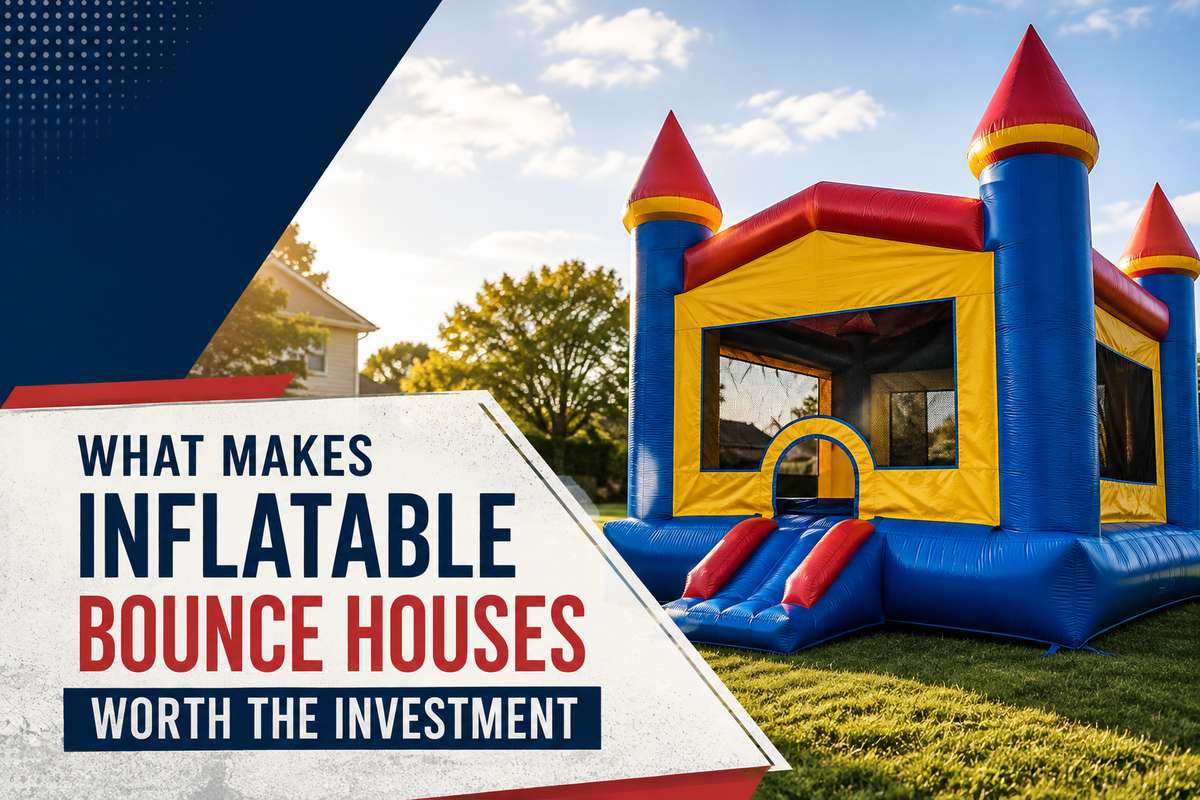
Buyers who compare sticker prices alone usually pay twice. A big-box bouncer built from light coated fabric is designed for a handful of backyard birthdays, not for weekly parties or paid rentals. Commercial units are built from PVC vinyl tarpaulin, with reinforced seams meant to survive repeated folding, hauling, and wet use.
The other half of the value equation is risk. The U.S. Consumer Product Safety Commission estimated more than 18,000 bounce house injuries treated in hospital emergency departments in 2018. A unit with correct anchor patches, full netting, an emergency exit, and a permanently affixed information plate is not a premium feature list. That hardware is what keeps a backyard party or a rental business out of an incident report.
What is the real difference between commercial and residential bounce houses?
The difference between commercial and residential bounce houses comes down to material, seam construction, and expected number of uses. Residential inflatables typically use coated nylon or Oxford polyester in the 210D to 800D range and are rated for light, occasional use. Commercial inflatables use PVC vinyl tarpaulin, a polyester scrim bonded between PVC film layers, which is waterproof, UV resistant, and repairable with a patch kit.
Weight answers the question at delivery. A commercial 13 ft by 13 ft bouncer is heavy enough that most buyers want a dolly and a second set of hands, while a residential unit with a similar footprint can be carried by one adult. The extra weight is the vinyl doing its job.
| What to check | Residential bounce house | Commercial bounce house |
| Typical material | Coated nylon or Oxford polyester, 210D to 800D | PVC vinyl, 15 oz to 20 oz per square yard |
| Seam construction | Single stitched | Double to quadruple stitched, reinforced at stress points |
| Intended use | Occasional family use | Repeat party, event, and rental use |
| Weather tolerance | Limited, degrades with sun and damp storage | Waterproof and UV resistant |
| Repairability | Often replaced rather than repaired | Patchable with a vinyl repair kit |
| Anchoring hardware | Light stakes, few anchor points | Reinforced anchor patches at every manufacturer point |
Choose a residential unit if the bouncer serves one family for a few weekends a year and lives in a dry garage between uses. Choose a commercial unit when the bouncer will be rented out, used at school, church, or community events, or shared by large groups across a full season.
Does 18 oz vinyl really last longer than 15 oz vinyl?
Vinyl weight describes ounces per square yard of material, so 18 oz vinyl is meaningfully heavier than 15 oz vinyl. Heavier is not automatically better. Extra weight buys puncture resistance, and it also adds freight cost, setup labor, storage bulk, and drying time after wet use.
What actually separates units that last is what happens at the seams and anchor points. Reinforcement webbing, double to quadruple stitching in high-stress areas, heat-sealed joints, and anchor patches that spread load across the panel matter more than the ounce rating on the spec sheet. A 15 oz unit with reinforced stress points regularly outlasts an 18 oz unit with thin stitching and undersized hardware.
Both weights sit inside the commercial-grade range, so the choice is about your operation. Manufacturers of commercial-grade bounce houses built for rental use publish vinyl weight, seam treatment, included accessories, and warranty terms broken out by dry and wet use, which is exactly the information you need to compare two units honestly. If a listing will not tell you the vinyl weight, treat that silence as an answer.
Choose 15 oz vinyl when transport weight, storage space, and fast turnaround between bookings matter most. Choose 18 oz vinyl when units run on abrasive surfaces, see continuous adult use, or live outdoors for multi-day events.
What construction details tell you a bounce house will last?
Construction details predict lifespan better than brand names. Work through this list on any unit you are considering, and ask for photos of the seams and anchor patches if the product page does not show them.
- Seam quality at stress corners. Look for double to quadruple stitching plus reinforcement webbing where walls meet the jumping floor.
- Anchor patches and rings. Reinforced, load-spreading patches at every manufacturer-specified point, not fabric loops sewn to a single layer.
- Netting on all open sides. Mesh should keep jumpers inside while letting supervising adults see in from outside.
- Roof and emergency exit. Shade matters in summer, and a marked emergency exit matters when a blower stops.
- Reinforced jumping floor. A doubled or extra-layered bounce surface is the single most worked part of the unit.
- Blower sizing. The unit should ship with the correct number and rating of commercial blowers for that model.
- Multi-zipper air release. Fast deflation shortens teardown and reduces the temptation to force a damp unit into its bag.
- Included kit. Stakes, repair kit, storage bag, and written care instructions should come standard, not as add-ons.
In practice, the first failure on a hard-working bouncer is rarely the middle of a panel. Failures start at the stitching where the wall meets the floor, at an anchor patch that took a sideways load in wind, and at a zipper forced shut while the vinyl was still damp.
How do you match the size and type to how you will actually use it?
Size decisions fail on logistics more often than on price. Before choosing a model, measure the setup area with clearance on all sides, measure the gate or doorway the rolled unit has to pass through, check your vehicle capacity, and check the storage footprint. Ask the manufacturer for rolled dimensions and shipping weight, because folded commercial vinyl takes more floor space than most first-time buyers expect.
| Unit type | Best for | Space and setup demands |
| Standard bouncer, about 13 ft by 13 ft | Backyard parties, younger children, a first rental unit | Level ground with clearance on all sides and overhead |
| Combo with slide and pool | Operators who want one unit that rents wet in summer and dry in winter | Larger footprint, water access, longer drying time |
| Water slide, 14 ft and taller | Warm climates and summer-heavy calendars | Big footprint, water supply, drainage, more setup labor |
| Obstacle course | Schools, camps, field days, corporate events | Long run of open ground and more staff to supervise |
| Sports or interactive inflatable | Team events, older children, adult guests | Moderate footprint, higher supervision ratio |
Choose one versatile combo if your budget only covers a single unit, because a bounce and slide combo can be booked wet or dry and serves a wider age range. Choose a standard bouncer when most of your bookings are small backyard parties for younger children and your crew loads units alone.
What does a bounce house actually cost to own, not just to buy?
Ownership cost decides whether inflatable bounce houses are worth the investment for your situation. Purchase price is one line in a longer budget that includes freight, power, insurance, cleaning, repair, storage, and eventual replacement. Run these numbers before you compare two units on price alone.
| Cost line | What to budget for |
| Purchase price | Quote by unit type and size |
| Freight or shipping | Quote per order; commercial vinyl ships heavy |
| Blower and power | Commercial units usually ship with the blowers they need. Budget a generator for sites without a nearby outlet. |
| Liability insurance | Quote from a carrier offering an inflatable amusement endorsement |
| Cleaning and repair | Vinyl patch kit, cleaner and disinfectant, and a reserve for seam repairs after peak season |
| Storage | Dry, temperature-stable space. Heat and damp storage shorten material life more than jumping does. |
| Replacement cycle | Set against your own use level and inspection record |
The number worth calculating is cost per use. Add purchase price, freight, and a year of insurance and maintenance, then divide by the number of times you honestly expect to set the unit up. Compare that figure to your local rental rate. Buyers who run this math usually stop shopping on price and start shopping on lifespan.
When does buying a bounce house make more sense than renting one?
When buying makes sense
Buying makes sense when the unit gets used often enough to beat rental economics, and when you control setup quality. Rental operators, schools, camps, churches, community centers, and families who host large gatherings several times a year land in this group. Buying also makes sense when you need the same unit on short notice during peak weekends, which is exactly when local rental inventory disappears.
How to compare your options
Compare options on four axes rather than price: material and seam construction, warranty terms split by dry and wet use, what ships in the box, and the manufacturer’s documented safety compliance. Ask each seller for the vinyl weight, the anchor point count, the blower specification, and the warranty period for wet use. A seller who answers all four quickly is telling you something useful about the product and the support behind it.
What results to expect
Expect a commercial unit to need routine care rather than zero care. Plan on cleaning and full drying after every wet booking, seasonal seam inspection, prompt patching of small punctures, and replacement of stakes and straps as they wear. That routine is what prevents most mid-season failures; storing units damp is what causes them.
Choose to buy if you expect regular use across multiple seasons, and you have dry storage plus a vehicle that can move the unit. Choose to rent when you need a bouncer once or twice a year, have nowhere dry to store it, or want a supplier to carry the setup, cleaning, and liability.
What safety standards and features should you check before you buy?
Safety standards are the fastest way to separate serious manufacturers from resellers. ASTM F2374 is the standard practice covering design, manufacture, installation, operation, maintenance, and inspection of commercial inflatable amusement devices. Home-use inflatables fall under a separate consumer standard, ASTM F2729, so a unit built to the consumer standard is not automatically fit for rental service.
Flame resistance is the second document to ask for. Commercial vinyl is commonly tested to NFPA 701 flame propagation test methods, and lead-free vinyl is standard for equipment used by children. Ask for the test documentation rather than accepting a claim on a product page.
Wind rules matter more than any other operating detail. CPSC guidance advises against using a bounce house in wind, with a maximum in the range of 15 to 25 mph, and manufacturer limits appear on the information plate affixed to the unit. Buy a handheld anemometer with your first unit and shut down at your stated limit rather than guessing from a weather app.
Anchoring hardware is the third check. Stakes for inflatable rides are long, driven deep, and specified by the manufacturer; hard surfaces call for ballast instead, and hard surfaces call for ballast instead of stakes. Confirm the unit has a reinforced anchor point everywhere the manufacturer specifies one, because partial anchoring is the failure mode behind most wind incidents.
Finally, check state rules. Several states regulate commercial inflatables as amusement rides and require registration, inspection, or state-approved equipment before a unit can be rented out. Check your state’s amusement ride program.
What buying mistakes do inflatable owners regret most?
Most regret traces back to a handful of avoidable decisions.
- Buying on sticker price. The cheapest unit almost always carries the shortest service life and the weakest seams.
- Ignoring storage. Packing a damp unit is the fastest route to mildew, odor, and vinyl failure.
- Skipping insurance. Renting out an inflatable without general liability coverage puts personal assets behind every booking.
- Underestimating logistics. Buyers regularly discover their vehicle, gate, or storage space cannot handle the unit they ordered.
- Treating anchoring as optional on hard surfaces. Concrete and asphalt setups need ballast at every anchor point, not fewer anchors.
- Buying a unit too specialized for the local market. A themed or oversized unit that only fits a handful of yards sits idle on peak weekends.
- Assuming the blower is universal. An undersized blower leaves walls soft, which changes how the unit behaves under load.
Frequently Asked Questions
How long does a commercial bounce house last?
Service life depends on use frequency, sun exposure, and storage discipline far more than on brand. A unit cleaned and fully dried after every booking, patched promptly, and stored in a dry, temperature-stable space will outlast an identical unit stored damp in a hot shed.
Is 18 oz vinyl worth paying more for than 15 oz?
Only when your use case is abrasive or adult-heavy. The 18 oz material is heavier per square yard and adds puncture resistance, freight cost, and handling weight. For crews loading units alone and turning bookings quickly, well-reinforced 15 oz vinyl is usually the better operational choice.
How many children can a standard bounce house hold?
Capacity is set by the manufacturer and printed on the unit, based on rider weight and height rather than age alone. Mixing large and small jumpers is a common cause of collision injuries, so most operators sort by size and run shorter rotations instead of filling to the stated maximum.
Can you set up a bounce house on concrete or asphalt?
Yes, when you replace stakes with ballast and protect the vinyl. CPSC guidance describes anchor weights for inflatable rides ranging from about 75 pounds for bounce-type units to 500 pounds for slide-type units at each anchor position. Lay a tarp under the unit on hard surfaces to reduce abrasion.
What wind speed is too high to run a bounce house?
CPSC advises that maximum wind speed should be no more than 15 to 25 mph, and the manufacturer limit on the unit’s information plate governs. Many operators use 15 mph as the shutdown trigger, evacuate riders, and deflate rather than waiting for a gust to make the decision.
Do you need insurance to rent out inflatable bounce houses?
General liability coverage with an inflatable amusement endorsement is standard practice for rental operations, and many venues, schools, and parks will not allow a setup without a certificate of insurance. Confirm requirements with the venue and your carrier before quoting a job.
How do you make the final call on a bounce house purchase?
What makes inflatable bounce houses worth the investment is a match between build quality and how hard you plan to use the unit. Ask for the vinyl weight, the seam and reinforcement detail, the anchor point count, the blower specification, the warranty split between dry and wet use, and documented compliance with ASTM F2374. A seller who answers all six without hesitation is worth buying from.
Read more buyer guides like this one before you spend money on equipment you will own for years, and keep the safety standards above in front of you while you compare models.
Author Profile

- Along with leading the team, Millard also works alongside different Fortune500 companies as their management Consultant/Financial Analyst, which shows his passion in helping other businesses grow.
Latest entries
 BusinessOctober 15, 2026What Are Trade-Offs In Business
 BusinessOctober 9, 2026What Is Medical Device Manufacturing Outsourcing
 BusinessOctober 3, 202619 Tips to Prepare for a Virtual Interview
 BusinessSeptember 27, 2026Best Forms Of Passive Income to Build Your Wealth